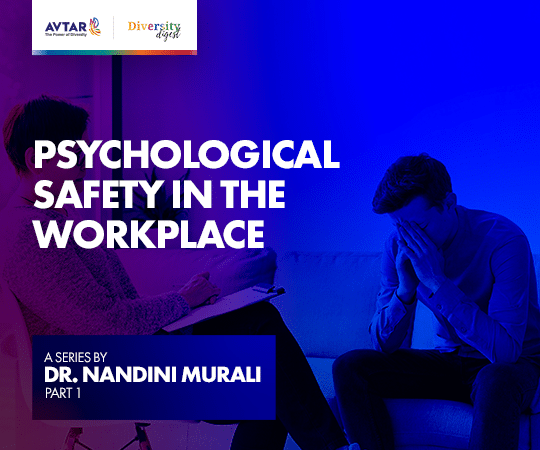
Psychological safety means it is not expensive to be yourself. It is not socially, politically, or emotionally expensive to be yourself.
-Dr. Timothy Clark, The 4 stages of psychological safety: Defining the path to Inclusion and Innovation
Let’s begin with two common instances at the workplace.
You are tasked with a new assignment. For you to gain clarity, you ask a question.
The team leader retorts sharply,” Oh, come on! What a stupid question! By now, the answer must be obvious to you!”
If like most people, you have experienced this, you are likely to hesitate several times before you muster the courage to ask a question before a group. In other words, stung by the barbs of shame and ridicule, you will self-retract like a snail into its shell and self-censor yourself.
In another instance, during the internal Monthly Review Meetings, there is an intense discussion about a critical issue at the workplace. You challenge the status quo by boldly explaining your perspective based on your core values that are aligned with the organizational values and your perceptive reading of the issue.
Your manager responds, “That’s amazing! Thank you for your perspective that has helped us view the situation from a different angle.” She later follows it up with an email that highlights your contribution and acknowledges your courage in speaking the truth to power.
Organizational behaviour expert Timothy Clark describes the two instances as examples of punished vulnerability and rewarded vulnerability, respectively. The former encourages self-preservation, self-censoring, loss avoidance and minimum compliance. The latter encourages discretionary effort, meaningful effort, and value creation.
The two examples illustrate that creating psychologically safe spaces at the workplace for candid courageous conversation is imperative in the modern workplace that is diverse, dynamic, disperse and digital (4Ds). In a workplace characterized by psychological safety, team members are unanimous that their environment supports the interpersonal risk in asking for help or learning from one’s mistakes.
Creating psychological safety in the workplace is central to the human experience. However, contrary to popular perception, it is an act of both individual and collective responsibility. Psychological safety in the workplace rests on for foundational pillars: choice, equity, equality, respect, and dignity (CREED). Our lives are embedded in an intricate web of relationships characterised by interdependence. Psychological safety stems from the underlying human need for connectedness and belongingness. When integrated as a core organizational and team value it has the potential to create a sanctuary of inclusion and an incubator of innovation.
Why psychological safety matters
Teams that consciously and intentionally promote and nurture psychological safety show the following characteristics:
- Willingness and receptivity to inputs from all team members
- Encourage team members to contribute authentically
- Promote active listening and create an environment of co learning.
- Admit and acknowledge mistakes with humility
- Appreciate openly
- Acknowledge one’s current limitations and willingness to unlearn, de learn and relearn.
The four stages of psychological safety
Based on the natural progression of human needs (from basic to advanced), Timothy Clark describes four stages of psychological safety that apply across demographic, psychographics, nations, and culture. Humans yearn to belong, contribute, and make a difference.
Stage 1: Inclusion safety: Do I feel included? Every person has a basic need to be accepted unconditionally. In fact, the need to be accepted precedes the need to be heard. Inclusion safety is a genuine invitation for a person to step inside a group without being judged on attributes and qualities. It is free of shame, ridicule, embarrassment, bullying, microaggressions and punishment. On the other hand, it nurtures self-confidence, connection, belongingness, and resilience.
Stage2: Learner safety: Am I growing? This satisfies the basic human need to learn, explore, experiment, express oneself and thereby grow and evolve.
Stage 3: Contributor safety: Am I making a difference? When we create contributor safety, we recognize and acknowledge people’s competencies and character; empower them with autonomy, guidance and co create space to offer meaningful contribution that is capable of impact.
Step 4: Challenger safety: Am I challenging the status quo? Challenger safety provides space to dissent; to disagree when something needs to change. It offers a counter narrative based on a set of core personal and organizational values together with informed perspectives. It offers an antidote to mindless conformity, herd mentality and offers permission to be creative and innovative.
Psychological safety is a catalyst for high performance highly inclusive workspaces. It rests on a foundation of CREED (Choice, respect, equity, equality, and respect) and can radically humanize workspaces.
“In the twenty-first century, high psychological safety will increasingly become a term of employment and organizations that don’t supply it will bleed out their top talent,” writes Timothy Clark in The 4 stages of psychological safety: Defining the path to Inclusion and Innovation.