
S&P Global’s vision is to nurture and sustain an environment that encourages inclusion and a deep sense of belonging, empowering people in the organization to contribute their unique insights within, for communities, and customers. Sugandha Srikanteswaran, Managing Director, Digital Technology Services India, S&P Global, talks to Avtar Insights offering a 360-degree look at their DEI initiatives that go beyond their organization.
Tell us about your DEI strategic pillars— people, customers, and community. How do you see these as linked?
Our company’s vision for DEI is to create an environment that encourages inclusion and a deep sense of belonging, where our people can bring their unique insights to work, the community, and to customers.
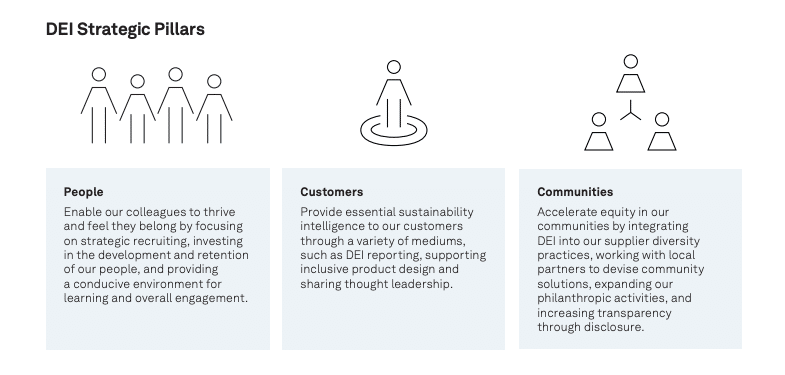
Reference – S&P Global DEI Report: https://www.spglobal.com/en/who-we-are/corporate-responsibility/DEI-report-2022.pdf
Our people-first policies are key to our engaged workforce, and they focus on all aspects of people, including wellness, education, belonging, and more. They have been built on employee feedback and include benefits like annual health checks, flexible paid time off, care leave, and multiple enhancements to support one’s lifestyle, time, pay, family, and career. We continued with our five Wellness Days in addition to the leave policy. People-First Policy also provides continuous learning and digital tool adoption for growth and development, including a Global Education Support program for current and past employees with Cornell and Emeritus.
We strive to provide Social Equity intelligence through our offerings to customers. Having been part of various community activities such as supporting local women entrepreneurs, recording books for the visually disabled, Comic script creations around Covid safety for young children, green city through plantation, lighting up space for children to study in villages, elderly care and more, our commitment to give back and creating a better place to live is strong. We also embrace diversity for our suppliers and in partner teams offering services. To help our colleagues build inclusion skills, we have adopted Eskalera as the DEI learning platform.
Earlier this year, S&P Global ranked #43 on ‘Top 50 India’s Best Companies to Work For – 2023″ by the Great Place to Work® Institute. Participating for the fifth consecutive year, S&P Global jumped 24 ranks from 67th last year. S&P Global has also won Great Place to Work certifications in 2019, 2020, 2021, and 2022, in addition to Top 50- India’s Best Workplaces for Women in 2022, India’s Best Workplaces in Diversity, Equity & Inclusion in 2021, India’s Best Workplace in Health and Wellness in 2020 and India’s Best Leaders in Times of Crisis in 2021. Recently, we were also recognized in Top 50 India’s Best WorkplacesTM for Millennials 2023.
As against ERGs or BRGs, you have PRGs or People Resource Groups at S&P Global. Share with us how the term people make a difference in your organization’s culture.
S&P Global’s vision is to create an environment that encourages inclusion and a deep sense of belonging, where our people feel empowered to contribute their unique insights within S&P Global, in their communities, and with our customers. The People Resource Groups are a representation of the same. Our people are the core of everything we do at S&P, hence the name “People Resource Groups”. PRGs play an important role in bringing our DEI strategy to life. The PRGs in the various locations are aligned to the regional context. They help with people development, retention, and engagement by providing safe spaces to our people and continued investment in the targeted development of underrepresented groups. Our PRGs through their programming and events create opportunities for their members to interact with senior leaders and learn from them.
Our PRGs help produce thought leadership by providing insights into the difficulties and challenges faced by underrepresented groups and how we can elevate them. They foster a sense of community and help accelerate equity in our communities by providing PRG members with volunteering opportunities and serving underserved communities using the Corporate Responsibility grant.
I am a member of a PRG called REACH (Reach: Championing People with Disabilities) and partner with Businesses to enable the workplace through various technologies.
What does it take to build this culture and how does it vary between regions? Can you answer this in the context of India?
The People Resource Group is run by the colleagues for the colleagues. Let’s call this the success factor because when we believe in DEI, we drive the DEI from each group and department that we are part of. One thing to note is that the PRGs may not be the same for all regions or operate the same way. It depends on the way a region’s diversity is and the framework of society to grow it. For eg: in India, the women who joined at entry levels are quite high in number and this changes during the mid-career timeframe. Hence the PRG for Women would tailor its programs and awareness towards that. Similarly enabling and onboarding neurodiverse talent requires a readiness of available talent pool, workplace readiness, and people readiness. The PRGs drive awareness and help create an inclusive workplace.
As we understand, Indian women’s workforce diversity is 5% lower than your global benchmark, what measures are being put in place to reduce the gap and go beyond?
Our overall Enterprise goal is to grow women talent across all locations. We have an engaging Re-Start program to bring Women back to work after a break bringing in an experience perspective with the eagerness to take on new work. We are also leading with below to expand our Women talent in India and having the additional focus on Women in Tech as that is an area where we like to grow more.
- Exclusive Hiring Drives – for women candidates on International Women’s Day, for technology hires by partnering with our in-house “Women in Technology” networking group
- Speed mentoring initiative undertaken by our Women’s Initiative for Networking and Success people resource group to create networking opportunities for women team members to have focused career growth guidance conversations.
- Participation at Grace Hopper and IT Pro Day celebration to promote and advance representation opportunities via learning sessions for women in the field of technology
- Maternity Management Program – Crafted with a design thinking approach and various focused group discussions with women team members to understand requirements and offer a one-stop-shop solution, this program not only guides women colleagues with benefits they can avail of during their motherhood phase but also serves as a quick reference guide for people managers to advise them on their career prospects and support which they can offer.
- The ‘People First’ policy has been built on employee feedback and has included benefits like increasing parental leave to 26 weeks, annual health checks, flexible paid time off, care leave, and multiple enhancements to support one’s lifestyle, time, pay, family, and career.
Our PRGs, as we spoke above enable not only women joiners but also intersectionality in women which helps with the nurturing and growth of women.
Why Women in Tech and what role does technology play for DEI?
More Women in Tech means more innovation, more business opportunities, role models, and helping bridge nations’ workforce/economic gap. We are seeing a good rise in Women in Product Management creating outside-in user feedback-based products. Our women in cybersecurity are quite ambitious and meticulous towards secured posture and creating necessary awareness among their colleagues. Some of the Women leaders have been passionate about other aspects of DEI and bringing in more diverse talent by embracing people with disabilities and creating a safe workplace to operate. Products designed and developed where women are part of the core team enable or provide support for Women at client organizations, thereby driving overall Women’s growth in the workplace. Our flagship platform EssentialTECH and Essential Innovation enables not only technology learning but also provides a platform for collaboration and innovation.
Technology is key to DEI. Digitization has enabled many women to access learning platforms and build new skills, technology has enabled people with vision challenges to be able to be in the software field, call centers, hospitality centers, and other fields of work.
Technology has enabled neurodivergent people to get job opportunities that bring out their strengths. The examples are plenty.
At S&P Global, we have a WIT (Women in Tech) focus group as part of the WINS (Women’s Initiative for Networking & Success) PRG. WIT is steered by a leadership team, globally and divisionally dispersed, supported by a regional network of local WIT chapter participation. The focus of this team is to make S&P Global a destination for top talent, support DEI initiatives within Technology and across SPGI, and provide unique opportunities for women to be dynamic leaders in the tech community.