
“Contrary to the assumption that language merely reflects social patterns such as sex and gender role stereotypes, research in linguistics and social psychology has shown that these are in fact facilitated and reinforced by language.”
—Marlis Hellinger in Language and Power.
Gender inclusive language, also known as non-sexist language, is an important aspect of Inclusive language. It is a means of communicating in a way that does not discriminate against a particular sex, gender or gender identity, and does not perpetuate gender stereotypes. Given the key role of language in shaping cultural and social attitudes, using gender-inclusive language is a powerful way to promote gender equality, address, and hopefully, eradicate gender bias.
Sexist language promotes, reinforces and maintains stereotypes and biases. It pigeon holes people according to gender. It assumes that the male is the norm—the significant gender or the Self and everyone else the Other.
Gender inclusive language, on the other hand, accords equal treatment and value to everyone regardless of their sex, gender, sexual orientation or gender identity. It either does not refer to a person’s sex or gender when it is irrelevant or refers to women and men in symmetrical ways.
Strategies for gender inclusive language
A number of strategies can be applied, when speaking or writing in English, to be more gender-inclusive:
- Use non-discriminatory language
An understanding of the differences between sex and gender is critical to the use of bias-free language.
Sex is genetic and biological. People with male genitals are male; people with female genitals a are female. Gender is socio cultural. Males and females, through a process of socio cultural conditioning, grow up into boys and girls who in turn become men and women respectively. Thus, our cultural notions of “masculine” tell us how we expect boys and men to behave and our notions of “feminine” tell us how we expect girls and women to behave.
For example, words like womanly/manly, tomboy/sissy, boyish/girlish, fatherly/motherly have nothing to do with a person’s sex. They are culturally acquired subjective concepts about character traits and expected behaviours of girls/women, boys/men that vary from one culture to another; from one person to another.
These sex-linked words derive their meanings from cultural stereotypes of what it means to be a boy/girl, man/woman. Since these words depend on interpretation of stereotypical characteristics or behaviour for their meanings, they may be grossly inaccurate and inappropriate when applied to individuals.
For example, it is biologically impossible for a man to breast feed; as it is for a woman to be a sperm donor. By the same reasoning, in some cultures, while it may be unusual for man to be a secretary or a woman to be surgeon, it is not biologically impossible. However, to presume that all secretaries are women and all surgeons are men is sexist because the issue is gender; not sex.
Gender thus describes a person’s personal, social and legal status without reference to genetic sex. Gender is a subjective cultural attitude. It is a cultural variable. Sex, on the other hand, is a biological constant.
The difference between sex and gender is crucial because much of sexist language arises from sociocultural determinants or gender role stereotypes of what a man or woman ought to be. For example, men are supposed to be rational logical and not show their feelings outwardly. Women, on the other hand, are expected to be submissive, docile, nurturing, caring and emotional.
- Avoid gender-biased expressions or expressions that reinforce gender stereotypes
From the above discussion, it is clear that expressions that reinforce gender stereotypes are discriminatory, sexist and to be avoided.
Examples:
- “She throws/runs/fights like a girl.”
- “In a manly way.”
- “Cooking, cleaning and caring—that’s women’s work.”
- “Thank you to the ladies for making the room more beautiful.”
- “Men are logical and rational; women irrational and emotional.”
“Feminine” endings
Suffixes like -ess (actor/actress, poet/ poetess) and –trix (executrix/executor) do three things:
- They reinforce the notion that the make is norm and the female is derivative or secondary. For example, a poet is defined as: “one who writes poetry” while a poetess is a “female poet.” This implies that men are “real” or primary and women, just extensions!
- These endings specify a person’s sex when gender is irrelevant.
- They carry the sense of littleness or cuteness (trivialization or infantilization).
- The purpose of a suffix is to qualify the root word. Why qualify a standard word describing standard human activity? A poet should be a poet—without qualification. The discounting and devaluation of the female member of word pair is the biggest argument against “feminine” endings. The parallelism invariably breaks down and the female word never acquires the prestige, respect and visibility associated with the male word.
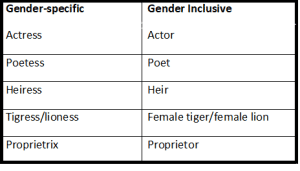
Important: If an individual’s sex is critical to your text or speech, use adjectives (“At a time when male actors played female roles”) or pronouns “(the poet interrupted her reading.”)
- Use of gender-inclusive generics
Generics are nouns and pronouns intended to be used for both women and men. Linguistically, however, some generics are male-specific, which excludes women and creates ambiguity. In many languages, the word “man” is generically used to mean human being or person, but it renders women invisible in language and leads to their portrayal as deviations from this “male/human” norm (for example in the words such as “mankind”, “the origin of man”, “early man”, “fatherland”, etc.)
This should be avoided by using gender-inclusive generics, thus ensuring that women are included and represented fairly in writing and conversation (for example, the words such as “humankind”, “the origin of humanity”, “early peoples-civilizations”, “homeland”, etc.)
- Avoid the pseudo (false) generic “He”
Haven’t we at some time used or heard people use he to mean he and she? This use of the pseudo generic he is based on the presumption that women are included too! However, this is clearly not the case as women are not really included as a distinct category but simply subsumed under the dominant category!
Let’s get this clear: When we specifically use he and imply that we mean both he and she, it actually means that the listener or reader hears it as referring to men only! The implication is that maleness is a primary state and femaleness is secondary or just peripheral!
The use of the expressions “she or he”, or “s/he” have long been acceptable substitutes for the generic “he, him, his”: ‘he’. Used sparingly, “she or he”, or “s/he” could be very helpful solutions. However, although these forms provide a quick solution, some readers might find them awkward or interruptive if overused. Other useful techniques to avoid the overuse of “she or he”, or “s/he”, depending of the context, could be the use of some other gender inclusive synonym, the use of “they, them, their”, “you, your”, and “one”, or simply by eliminating personal pronouns in any other way.
Some writers choose to preface the use of pseudo generics with an acknowledgment of the generic usage (disclaimer). However, it is advisable to avoid this technique to the extent possible, since it may suggest that there is recognition of unavoidability of the man-specific terms and the value system attached to them.
- Occupational titles: The suffix ‘-man’ is used frequently in occupational titles and related designations (for example, “chairman”, “spokesman”, “policeman”, “businessman” etc.) Occupational terms or job titles often convey assumed gender or class norms through the inclusion of irrelevant details and gender modifiers. Titles that convey identity modifiers can be altered in a number of different ways to remove specification (for example, “chairperson”, “spokesperson”, “police officer”, “businessperson” etc.)
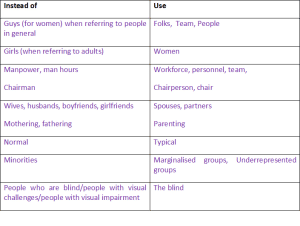
- Marital status of women: It is advisable to avoid identifying a woman as somebody’s wife, widow, mother, grandmother or aunt, unless it is relevant in context and if men are described similarly. For instance, in the recent pandemic, we have descriptors such as COVID widows and COVID orphans which is sensationalist, insensitive and presumes a secondary status for women.
The use of the conventional titles ‘Mrs’ and ‘Miss’ defines women only in terms of their marital status, i.e., in terms of their relationship to men, whereas men are hardly ever described in terms of their relationship to women. The term ‘Ms’ can be used for all women regardless of marital status.
- Gender inclusive pronouns: Here are four strategies to address the sticky issue of biased pronouns:
- Pairing: Use she/he
- Alternating: Use “she: in instance 1; “he” in instance 2.
- Pluralizing: Nouns like “doctor” and singular pronouns are
- Singular they: Use “They,” “Their” “Theirs” when speaking about individuals.
Every Friday, watch this space to read Dr. Nandini Murali discuss different facets of a topic in a four-part series over a month. Offering a 360-degree view, she takes readers into the different dimensions through anecdotes, backing them with data.