
“Until we learn to appreciate the power of language and the importance of using it responsibly, we will continue to produce negative social consequences for those victimized by dangerous language habits.”
J. Dan Rothwell, Telling It Like It Isn’t: Language Misuse and Malpractice/What We Can Do About It
Do you want to be known by your diabetes, any other health issue, your gynaecological history or the warts and moles on your body? If the answer is no, it’s time we extended this intentionality to people across diversity strands. Let’s then explore the power of language to intentionally include or unintentionally exclude with reference to persons with disability.
Disability is a club where our membership is always by chance and not our choice. We can be inducted into this club through birth (genetic or congenital conditions), through accidents, illness or the aging process.
Given that disability can happen to anyone at any point in our lives, we need to ask ourselves:
- How then would we want to be described?
- By our medical diagnosis?
- Or as a person who, incidentally, has a disability?
- Do we want to be known by our eye problems, infections, blood pressure, diabetes, spinal cord injuries or cognitive impairments?
A disability is just one part of a person’s life. It may be a huge part; but it still is not the person’s entire life. It is important to remember that a disability is something the person has; the disability is always secondary to the person. A disability is a medical diagnosis. Using medical diagnosis as a reflection of a person’s ability or description is devaluing and discriminatory.
My long years of engagement with persons with disability has given me an insider’s view of the impact of language in reinforcing and perpetuating stigma and negative stereotypes that lead to discrimination and exclusion based on perceived differences. Several friends, who are persons with disability, spearhead a robust disability activism spurred by their lived experience of disability. They unanimously declare that across the world, the greatest barrier experienced by persons with disability is not their disability per se but people’s attitudes! Significantly, the language we use reflect people’s attitudes; our attitudes are reflected in language and our attitudes drive our actions!
For example, initially persons with disability were seen as objects of pity or charity. This later gave way to the medical model of disability, where people were defined narrowly by their medical diagnosis. However, the current psychosocial model of disability based on a rights framework recognises that persons with disability function in a eco system that needs to be accepting and welcoming of them based on the core values of quality, choice, dignity and respect. In other words, their human rights are non-negotiable.
These developments set the stage for People First Language as a sensitive and respectful way of talking about persons with disability. People First Language (PFL), as the name implies, centres on the person; not their disability. It avoids using disability as descriptors or adjectives because it believes that disability is a condition that a person has; not is.
Examples:
- Is it a person with disability or a disabled person?
- Is it a person with a mental health condition or a mentally ill person?
- Is it a person with diabetes or a diabetic person?
In each of the above instances, the second option is an example of PFL. Using a disability to define a person is bias, perpetuates stigma and discrimination against persons with disability, disempowering and depriving them of their human rights.
PFL reflects the need to accord dignity, respect, equality and choice towards persons with disability, which is also the four pillars of Inclusivity. PFL is based on a rights based framework that recognises and values their need to be treated with dignity and respect. It was spearheaded by persons with disability who collectively voiced their belief that “We are not our disability!”
- People First Language, as the name implies, is people-centric.
- It places the person before the disability. It describes what a person has; not what a person
Guidelines for use of PFL
- A disability descriptor is a medical diagnosis.
- It does not define the person.
- PFL is about respect and dignity and places the person before the disability.
- There are more similarities than differences between a person with disability and a person without disability.
- Differences can never be the basis of discrimination.
Like gender, ethnicity and other traits, disability too is a natural part of being human. PFL highlights that differences can never be the basis of discrimination—intentional or intentional.
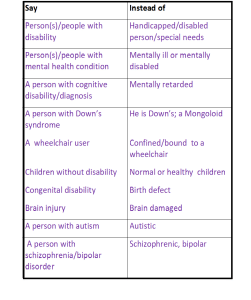
A few examples of People First Language
Every Friday, watch this space to read Dr. Nandini Murali discuss different facets of a topic in a four-part series over a month. Offering a 360-degree view, she takes readers into the different dimensions through anecdotes, backing them with data.