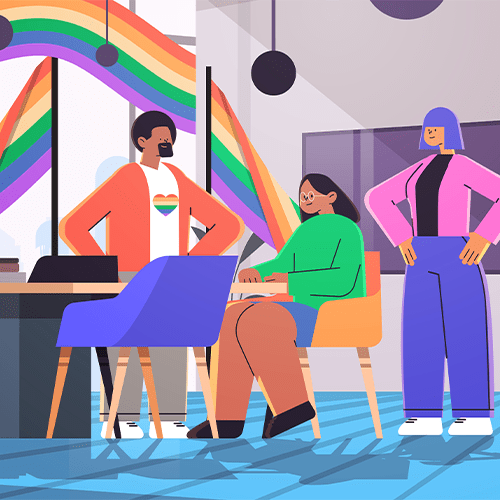
Every June, organisations across the world drape themselves in the colours of the rainbow. Social media feeds fill with messages of solidarity, office receptions display Pride flags, and carefully worded statements affirm commitments to inclusion. Visibility matters. Representation matters. But over the years, I have often found myself wondering: what happens after June ends?
What does inclusion feel like for the person who still hesitates before mentioning their partner at work? For the employee who constantly edits their language to avoid questions? For the trans person who walks into an interview already anticipating discomfort, curiosity, or rejection?
Pride, to me, has never been merely celebratory. It has always carried within it stories of courage, exhaustion, invisibility, resistance, and the deeply human desire to belong. My own understanding of allyship did not emerge from corporate frameworks or diversity terminology. It emerged from relationships and listening.
Many years ago, my journey into allyship deepened while co-authoring A Life in Trans Activism with Revathi — trans activist, writer, and a self-identified trans person. Long before conversations around gender diversity became more visible in mainstream discourse, Revathi was speaking with extraordinary honesty about identity, exclusion, violence, dignity, and survival. Working alongside her changed me profoundly. There are some experiences that quietly alter the architecture of your thinking. This was one of them.
As I listened to her life experiences, I began to understand the relentless emotional labour demanded of people whose very existence is constantly questioned by society. I understood more deeply what it means to move through institutions that were never designed with your dignity in mind. I also recognised how casually systems can wound — through silence, bureaucracy, mockery, invisibilisation, or simply the absence of empathy.
That journey taught me that allyship is not performative. It is not about rescuing. It is not about occupying moral high ground. Increasingly, I find myself drawn to the language of accompliceship rather than allyship alone.
Because allyship, too often, risks becoming symbolic — a carefully worded statement, a rainbow logo in June, a panel discussion, a performative posture that asks for very little discomfort from those in positions of privilege.
Accompliceship demands more. It asks us to move from passive empathy to appropriate action. To recognise that allyship is not a noun one claims, but a verb one practises. It requires a willingness to interrupt exclusion even when it is inconvenient. To challenge discriminatory behaviour in meetings and systems. To redistribute opportunity, visibility, and voice. To remain present not only during celebratory moments, but also during moments of backlash, discomfort, or silence.
If allyship says, “I support you,” accompliceship asks, “What am I willing to risk, question, or change to make equity real?”
And perhaps that is the deeper shift workplaces need today. Not performative inclusion. Not tokenistic gestures. But courageous participation in building cultures where dignity is actively protected.
If anything, true allyship — or rather accompliceship — demands humility. It asks us to listen more than we speak. To examine our own assumptions. To notice exclusion even when it is subtle. To intervene when silence feels more comfortable. And perhaps most importantly, to recognise that inclusion is not generosity. It is justice.
Over the years, I have worked extensively with organisations on workplace wellness, inclusion, gender, and psychological safety. Increasingly, companies today speak the language of diversity and equity with confidence. Yet employees often know intuitively whether inclusion is deeply embedded in culture or merely articulated in presentations.
A policy alone cannot create belonging. A rainbow logo alone cannot create psychological safety. A Pride Month panel discussion alone cannot undo everyday exclusion. Culture reveals itself quietly. In who gets interrupted. In whose discomfort is ignored. In whose identity becomes the subject of jokes. In whether people feel safe enough to speak openly about their lives without fearing judgment or professional consequences.
This is where leadership becomes deeply important. I have always believed that leadership is not revealed during carefully scripted speeches. It reveals itself in everyday moments of courage, empathy, and accountability. Inclusive leaders create cultures where dignity becomes non-negotiable. Where curiosity replaces prejudice. Where respect is practised consistently, not selectively.
Several organisations globally have attempted to move meaningfully in this direction. Accenture, for instance, has invested significantly in LGBTQIA+ inclusion through leadership advocacy, employee support systems, inclusive benefits, and visible representation across organisational levels. Similarly, Microsoft has consistently foregrounded accessibility, allyship, and inclusive workplace practices as integral to innovation and organisational culture.
What is significant in such examples is not perfection — no institution is perfect — but intentionality. Employees recognise when leadership commitment is genuine. Closer home in India, conversations around LGBTQIA+ inclusion have certainly evolved over the past decade. The reading down of Section 377 marked an important legal milestone, but social transformation moves far more slowly than legislation.
Many LGBTQIA+ individuals continue to negotiate invisibility within families, workplaces, educational institutions, and public spaces. For trans and non-binary individuals especially, the barriers remain layered and deeply structural — from documentation and healthcare access to hiring discrimination and everyday social stigma.
This is precisely why allyship within workplaces matters. Sometimes allyship is visible in large institutional commitments. But very often, it lives in ordinary moments. The colleague who chooses not to laugh at a derogatory joke. The manager who asks respectfully about pronouns. The leader who acknowledges bias instead of becoming defensive. The HR professional who questions whether existing systems unintentionally exclude certain identities.
These moments matter more than organisations often realise.
At its deepest level, Pride asks us an uncomfortable but necessary question: Can people exist fully and authentically within our workplaces without paying an emotional price for it? Because tolerance is different from belonging. Tolerance merely permits existence. Belonging affirms humanity. And human beings do not flourish when they are merely tolerated. They flourish when they are respected, seen, heard, valued, and safe.
Research often highlights how inclusive workplaces foster innovation, trust, engagement, and collaboration. All of that is important. But for me, the argument for inclusion has always extended beyond productivity metrics. It is fundamentally about humanity.
Behind every conversation on Pride or inclusion is a deeply personal story. A story of someone learning to survive invisibility. Someone carrying shame that never belonged to them. Someone searching for language, acceptance, dignity, or home.
Perhaps that is what Pride continues to remind us. Not simply to celebrate difference. But to build a world — and workplaces — where people do not have to fragment themselves to belong.
And I believe leadership, at its absolute best, has the power to make that possible.